https://www.babyblaue-seiten.de/album_22336.html
Translation:
From: Gunnar Claußen @
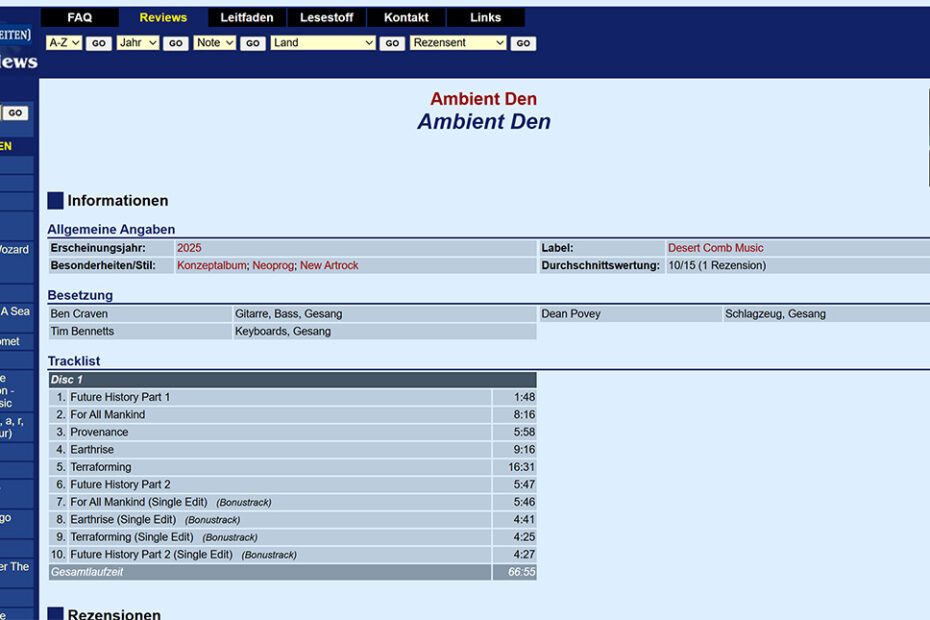
Well, the Australian trio Ambient Den quickly clears up the joke, or rather the misunderstanding, surrounding their name: No, they don’t play ambient music, but simply searched for (and found) an anagram formed by combining their three first names. So, what you hear is the music of Ben, Tim, and Dean, and at least the former is no stranger to these pages: Ben Craven has recorded four albums since 2011, all of which have been generally well-received here, and surprisingly, “Ambient Den” is also the first collaboration with other musicians that I’m aware of. However, Craven was apparently also involved in the Frankenfido project, which drummer Dean Povey is listed as being part of in the press release, and Seven Day Mask, whose members include keyboardist Tim Bennetts (who can be heard here), also hail from Brisbane. So it’s entirely possible that the members only met during this collaboration – which, incidentally, is said to have come about under the influence of the lockdown experiences at the beginning of this decade. On the other hand, one could also joke that it would hardly be recognizable as a Ben Craven album if, as already happened on ” Great & Terrible Potions ” and ” Monsters From The ID “, a single edit of almost every album track hadn’t been added as a bonus.
“Ambient Den” is framed by the two “Future History” sections, which, while not melodically very similar and differing in that the first part is an intro, while the second functions as a separate song – more on that shortly. The tracks do, however, serve a purpose in that Ambient Den view their album as a concept work about humanity’s journey into space and the colonization of a new world. Personally, I wouldn’t place too much emphasis on this conceptual aspect, as the songs can easily stand on their own, and the atmosphere is perhaps the most effective means of creating any sense of tension or narrative arc. Given that “For All Mankind” is somewhat mainstream in parts, “Provenance” is an instrumental, “Earthrise” alternates between sweetness and melancholy, “Terraforming” – not entirely inappropriately for its title – actually touches on all possible styles, and “Future History Part 2” strikes burlesque and playful tones, this is also rather special, and it would therefore be more productive to concentrate on the songs themselves.
Stylistically, Ambient Den lie somewhere in the neo-prog realm. Their music is characterized by motifs on keyboards and guitar, the latter lending a certain serene air with its rather sighing solos, while the keyboards provide the key elements: solemn moments with choirs, more delicate sections with piano runs, rocking drive with organ, and occasional glimpses of lively brass (in the reggae-like rhythm of “Future History Part 2”), glockenspiel (alongside the synth melody in “For All Mankind”), or even a solo on the electric piano (“Terraforming”). A more modern touch is added by ostinatos in the accompaniments (for example, in “Provenance” or “Earthrise”), occasional odd time signatures (7/8 time in “For All Mankind” or a 6+4+4 passage in “Terraforming”), and, of course, a generally atmospheric approach. Ah yes, and this playful approach continues elsewhere as well. For example, in “Earthrise” there’s a break with acoustic guitars and castanets (which, however, doesn’t remind me of Genesis’ ” Mad Man Moon ,” but rather, oddly enough, of the bolero section from Asia’s ” Cutting It Fine “?!), later in the same song there are first slide guitars and then a “Gimme Gimme Gimme!”-style disco bass, and in “Terraforming” there’s another peculiar section with a folk-style solo acoustic guitar and a Christmas-like tambourine – something similar to this was, of course, also featured in Mike Oldfield’s ” Ommadawn .”
These kinds of elements certainly liven up the otherwise solid, but also somewhat staid and restrained music considerably – although the aforementioned attributes apply primarily to the beginnings of “For All Mankind” and “Earthrise,” which each feature two melodically complex verses interspersed with the somewhat more upbeat choruses. “Provenance” could be described as similar in mood. While the music does break free from this with the instrumental passages, the three to four “normal” minutes at the beginning and sometimes also at the end, with the return of the chorus, are quite bearable. It is generally the rhythm (as mentioned, the 7/8 time signature in “For All Mankind”) and the often rather unusual harmonies that keep the listener engaged. “Terraforming,” on the other hand, doesn’t have this foundation; as a long track, it does indeed consist of a sequence of different sections. However, some solo passages have a rather casual, live-jam feel, like the runs in this piece. Ultimately, “Future History Part 2” isn’t without its flaws either. As fun as the track starts with its funky wah-wah sounds and crunchy bass (and as much as it stands out from the deadly serious stuff Neal Morse has been releasing lately), the guitar solos in the second half are aimless and could definitely use some more defined points of reference.
So, unfortunately, “Ambient Den” does have a few minor flaws, but overall it remains a fairly accurate genre piece that, conversely, boasts some curious ideas and the sure-footedness of its musicians. And who knows, perhaps the press release, which speaks of a ” musical chemistry reminiscent of David Gilmour & Rick Wright, or Mike Rutherford & Tony Banks, ” isn’t exaggerating after all. In that subgenre of prog rock that hovers between tradition and modernity, there have certainly been significantly weaker performances recently than this one from the Australian trio.
Recommended track(s): It’s best to try out “Earthrise”, that will give you a good overview.
Similar to: Marathon, Pendragon, Pink Floyd after Roger Waters, Johannes Luley, Mike Oldfield
Published on: July 22, 2025
Last updated: July 22, 2025
Original:
Von: Gunnar Claußen @
Tja, den Witz bzw. das Missverständnis um seinen Namen räumt das australische Trio Ambient Den recht schnell selber beiseite: Nein, man spielt keinen Ambient, sondern hat einfach ein Anagramm gesucht (und gefunden), das sich durch die Kombination der drei Vornamen ergibt. Zu hören ist also die Musik von Ben, Tim und Dean, und zumindest ersterer ist auf diesen Seiten kein Unbekannter: Ben Craven hat seit 2011 vier bei uns tendenziell gut angekommene Alben aufgenommen, und überraschenderweise ist “Ambient Den” dann auch die erste mir bekannte Zusammenarbeit seinerseits mit anderen Musikern überhaupt. Jedoch: Am Projekt Frankenfido, mit dem Schlagzeuger Dean Povey im Infotext ausgewiesen wird, war Craven offenbar ebenso beteiligt, und Seven Day Mask, hinter denen u.a. der hier zu hörende Keyboarder Tim Bennetts stehen soll, stammen ebenfalls aus Brisbane. Es ist also wohl alles andere als ausgeschlossen, dass sich die Besetzung erst bei dieser Zusammenarbeit hier – die im Übrigen unter dem Eindruck der Lockdown-Erfahrungen Anfang dieses Jahrzehnts zustandegekommen sein soll – kennengelernt hat. Andererseits: Man könnte auch frotzeln, es wäre wohl kaum als Ben-Craven-Album erkennbar, wenn nicht auch hier, wie schon auf “Great & Terrible Potions” und “Monsters From The ID” geschehen, von fast jedem Albentrack noch ein Single-Edit als Bonus angehängt wäre.
Eingerahmt wird “Ambient Den” jedenfalls von den beiden “Future History”-Teilen, die zwar melodisch nicht so viel miteinander zu tun haben und sich auch dahingehend unterscheiden, dass der erste Teil eben ein Intro ist, während der zweite als eigener Song durchgeht – mehr dazu in Kürze. Eine Funktion haben die Stücke aber natürlich in der Hinsicht, dass Ambient Den ihr Album als Konzeptwerk über den Aufbruch der Menschheit ins Weltall und die Besiedlung einer neuen Welt sehen. Nun ja, diesen Konzeptcharakter würde ich persönlich nicht so hoch hängen, denn die Songs können ebenso gut für sich stehen und für einen Spannungs- oder Handlungsbogen sorgen vielleicht am ehesten noch die Stimmungen. Angesichts dessen, dass “For All Mankind” teils etwas mainstreamig geraten ist, “Provenance” ein Instrumental darstellt, “Earthrise” wiederum zwischen Süße und Melancholie changiert, “Terraforming” – nicht ganz unpassend zu seinem Titel – tatsächlich alle möglichen Stile tangiert und “Future History Part 2” wiederum burleske und verspielte Töne anschlägt, ist das aber wiederum auch eher speziell geraten, und es wäre so gesehen eben doch zielführender, sich auf die Songs an sich zu konzentrieren.
Stilistisch liegen Ambient Den im weitesten Sinne irgendwo im Neoprog-Bereich. Geprägt ist die Musik von Motiven auf Keyboards und Gitarre, wobei letztere mit eher seufzendem Solieren für eine gewisse gesetzte Haltung sorgt, während von Tastenseite wiederum Stichworte geliefert werden: Feierliche Momente mit Chören, feinere Abschnitte mit Klavierläufen, rockigen Schub mit Orgel und daneben auch noch Seitenblicke durch beschwingte Bläser (zum Reggae-artig rhythmisierten “Future History Part 2”), Glockenspiel (neben der Synth-Melodie in “For All Mankind”) oder auch mal ein Solo auf dem E-Piano (“Terraforming”). Für einen gewissen moderneren Touch sorgen wiederum Ostinati in den Begleitungen (etwa in “Provenance” oder “Earthrise”), auch mal krumme Rhythmen (7/8-Takt in “For All Mankind” oder eine 6+4+4-Passage in “Terraforming”) und natürlich generell eine teils eher atmosphärische Ausrichtung. Ah ja, und die erwähnte Spielerei setzt sich wiederum auch anderswo fort. So gibt’s in “Earthrise” ein Break mit A-Gitarren und Kastagnetten (was mich allerdings nicht etwa an Genesis’ “Mad Man Moon” erinnert, sondern eigenartigerweise an den Bolero-Part aus Asias “Cutting It Fine”?!), später im selben Song erst Slide-Gitarren und dann einen “Gimme Gimme Gimme!”-artigen Disco-Bass und in “Terraforming” wiederum einen eigenartigen Abschnitt mit folkig solierender A-Gitarre und dazu weihnachtlich anmutendem Schellenkranz – etwas in dieser Art gab’s bekanntlich u.a. in Mike Oldfields “Ommadawn”.
Mittel dieser Art jedenfalls lockern die an sich zwar solide, aber auch etwas biedere und zurückhaltende Musik ungemein auf – wobei die genannten Attribute vorwiegend auf die Anfänge von “For All Mankind” und “Earthrise” zutreffen, in denen es jeweils zwei immerhin melodisch nicht ganz simple Strophen und dazwischen eben die etwas erhöhten Refrains gibt, und auch “Provenance” wäre von der Stimmung her ähnlich zu sehen. Hiervon kann sich die Musik dann zwar jeweils eben mit den Instrumentalpassagen lösen, aber 3-4 “normale” Minuten sind am Anfang und teils auch am Ende mit der Rückkehr eben des Refrains jeweils durchaus zu erdulden. Es sind dann in der Regel auch die Rhythmik (wie gesagt, der 7/8-Takt in “For All Mankind”) und die öfters auch mal eher abwegige Harmonik, die hier bei der Stange halten. “Terraforming” wiederum hat diese Basis zwar nicht, sondern besteht als Longtrack in der Tat aus einer Abfolge verschiedener Abschnitte, aber einige Solopassagen haben dann wiederum einen eher unverbindlichen Live-Jam-Charakter, sowas wie die Laufmaschen dieses Stücks. Schlussendlich ist auch “Future History Part 2” nicht frei von kleinen Dämpfern, denn so lustig das Stück mit seinen funkigen Wah-Wah-Sounds und dem knarzigen Bass auch anfängt (und so sehr es sich damit von dem bierernsten Zeug absetzt, das Neal Morse zuletzt so von sich hören ließ), so ziellos ist das Solieren der Gitarre in der zweiten Hälfte, das durchaus auch mal einige Fixpunkte ansteuern könnte.
Kleine Abzüge sind für “Ambient Den” also so gesehen leider drin, aber im Großen und Ganzen bleibt ein recht akkurates Genrewerk, das umgekehrt einige kuriose Einfälle und die Trittsicherheit seiner Musiker für sich verbuchen kann. Und wer weiß, vielleicht nimmt der Infotext, der hier von einer “musical chemistry reminescent of David Gilmour & Rick Wright, or Mike Rutherford & Tony Banks” spricht, den Mund vielleicht doch nicht zu voll. In jener Spielart des Prog, die halb zwischen Tradition und Moderne in der Schwebe hängt, gab es in letzter Zeit jedenfalls bedeutend schwächere Vorstellungen als diese des australischen Trios.
Anspieltipp(s): am besten “Earthrise” antesten, da kriegt man schon einen Überblick
Vergleichbar mit: Marathon, Pendragon, Pink Floyd nach Roger Waters, Johannes Luley, Mike Oldfield
Veröffentlicht am: 22.7.2025
Letzte Änderung: 22.7.2025